The best car audio systems for sound quality
The best car audio systems for sound quality are rarely the loudest or the most expensive. They are well-matched systems: a head unit with real sound controls, speakers that are better than the paper cones your car left the factory with, and enough clean power to drive them, with a subwoofer taking the deep bass off the door speakers. We picked nine components from Kenwood, Sony, Alpine, Focal, JBL, Pioneer and Kicker, grouped by the job they do, so you can build a system that suits your car, your music and your budget.
- Kenwood's eXcelon DMX958XR is the best head unit here for sound quality
- Focal's Auditor EVO ASE165 component set is the biggest single upgrade for clarity
- A small powered sub such as the JBL BassPro SL2 adds real bass without losing trunk space
Key takeaways
- Speakers matter most Factory speakers are usually the weakest link. New front speakers make the biggest difference you can hear for the money.
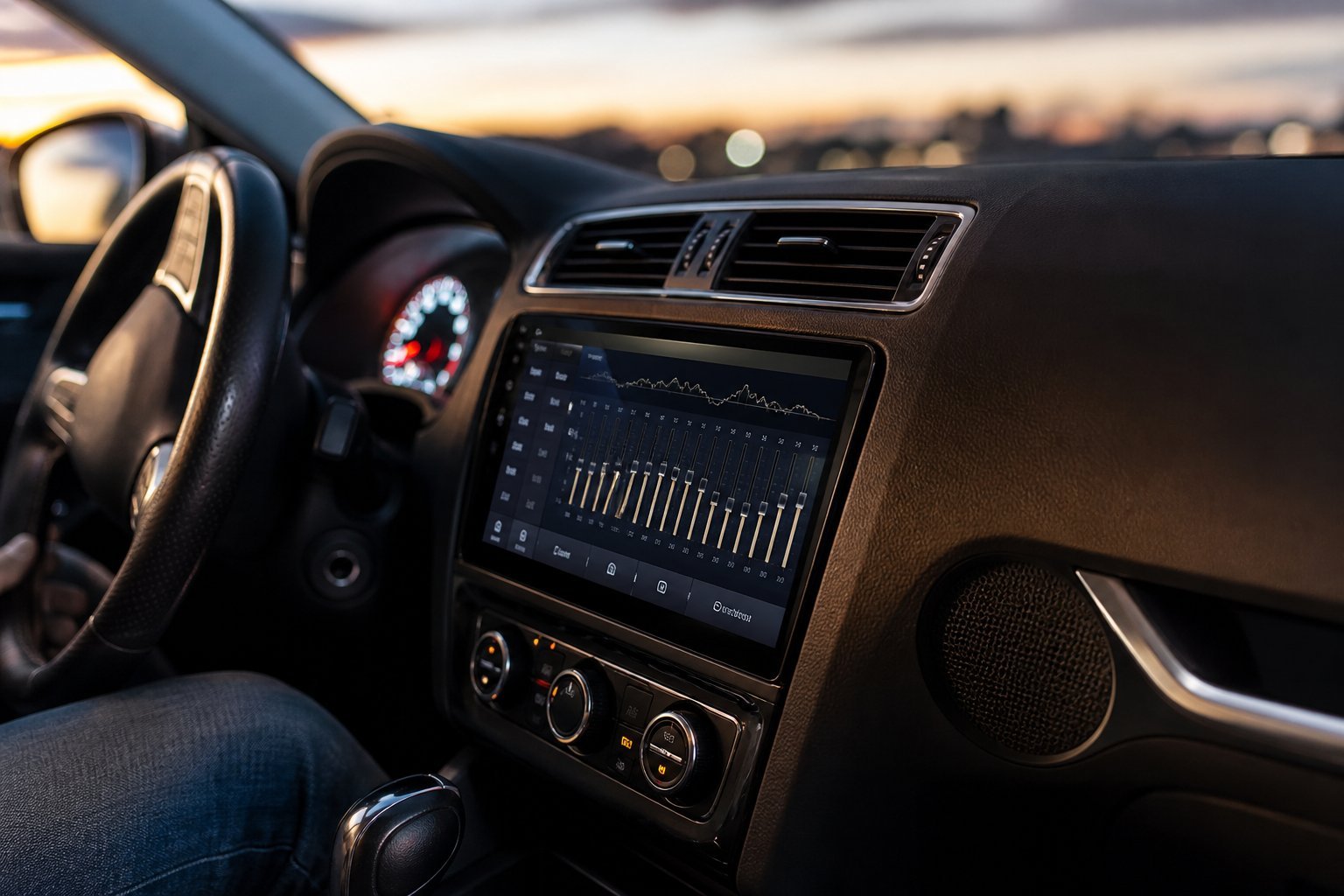
- Tuning beats watts Time alignment and a many-band equalizer put the sound in front of you. All three head units here have them.
- Give the bass its own speaker A subwoofer frees your door speakers from deep bass, so they play cleaner and louder.
- Build in stages Head unit, then front speakers, then an amp and sub. Each step works on its own.


Head units compared
|
Best head unit
Kenwood DMX958XR
|
Best value
Sony XAV-AX6000
|
Budget pick
Alpine iLX-W670
|
|
|---|---|---|---|
|
|
|
|
|
| Screen | 6.8 in, 1280 x 720 | 6.95 in | 7 in |
| CarPlay / Android Auto | Wireless + wired | Wireless + wired | Wired |
| Sound tuning | 13-band EQ, time alignment | 14-band EQ, time alignment | 13-band EQ, time correction |
| Hi-res audio | FLAC/WAV 24-bit, LDAC | FLAC 24-bit, LDAC | Not advertised |
| Our score | 9.4 /10 | 9.1 /10 | 8.6 /10 |
| Price | – | – | – |
| View | View | View |
Car speakers compared
|
Best speakers
Focal Auditor EVO
|
Drop-in upgrade
JBL Club 64
|
Budget pick
Pioneer TS-A653FH
|
|
|---|---|---|---|
|
|
|
|
|
| Type | 2-way component | 2-way coaxial | 2-way coaxial |
| Power (RMS) | 60 W | 60 W | 75 W |
| Sensitivity | 91.5 dB | 93 dB | 91 dB |
| Frequency range | 60 Hz-21 kHz | 48 Hz-21 kHz | 40 Hz-49 kHz |
| Our score | 9.2 /10 | 8.8 /10 | 8.5 /10 |
| Price | – | – | – |
| View | View | View |
Amplifiers and subwoofers compared
|
Easiest bass
JBL BassPro SL2
|
Best 4-ch amp
Pioneer GM-A6704
|
For builders
Kicker CompR 10
|
|
|---|---|---|---|
|
|
|
|
|
| What it is | Powered 8 in sub | 4-channel amp | 10 in sub driver |
| Power | 125 W RMS built in | 60 W RMS x 4 | Handles 400 W RMS |
| You also need | Wiring kit | Wiring kit | Box, mono amp, wiring |
| Our score | 8.8 /10 | 8.7 /10 | 8.6 /10 |
| Price | – | – | – |
| View | View | View |
How we chose the best car audio systems
We did not bench-test this gear ourselves. We compared the makers’ published specifications, independent dealer and reviewer write-ups, and owner feedback, and we only picked products sold on Amazon.com from established car audio brands.
-
Sound controls first
For head units we put tuning tools ahead of screen size: a multi-band equalizer, time alignment, crossovers and high-voltage pre-outs for adding amplifiers later.
-
Real power ratings
We compared RMS (continuous) power and sensitivity, not peak watts, because those are the figures that tell you how a speaker will sound on the power you have.
-
A path to upgrade
Every pick works on its own and fits into a bigger system later, so you can build the system in stages.
-
Fit and installation
We favored standard sizes (double-DIN, 6.5-inch) and noted what else you need to buy, such as wiring kits, dash kits and enclosures.
The best car audio systems for sound quality: detailed reviews
A car audio system has four parts: the head unit (the source and the sound controls), the speakers, the amplifier and the subwoofer. We have grouped the picks the same way. Live prices are shown on each card. For more on each part, see our car audio guides.
Best head units for sound quality
The best head unit for sound quality
If you want the head unit at the heart of one of the best car audio systems, this is it. Kenwood’s eXcelon Reference DMX958XR plays hi-res FLAC and WAV files up to 192 kHz/24-bit and streams over LDAC, so a lossless source reaches your speakers intact. More importantly, it gives you the tools to tune a car properly: a 13-band graphic equalizer, digital time alignment and a 3-way crossover, plus three 5-volt pre-outs for clean, low-noise feeds to external amplifiers. Kenwood lists the full feature set on its official DMX958XR page.
Day to day it is just as strong. The 6.8-inch capacitive screen runs at 1280 x 720, wireless Apple CarPlay and Android Auto connect as soon as you get in, and there are four camera inputs. It costs more than the others here, but it is a head unit you will not outgrow as you add amps and speakers.
- 13-band EQ, time alignment and 3-way crossover
- Three 5-volt pre-outs for future amplifiers
- Hi-res FLAC/WAV playback and LDAC streaming
- Sharp 1280 x 720 capacitive screen
- The most expensive head unit here
- No CD slot
- The full tuning menu takes time to learn
Flagship-style sound controls for much less
Sony’s XAV-AX6000 gets surprisingly close to the Kenwood for sound. Its built-in DSP offers time alignment in 1 cm steps for each of its five channels, a 14-band equalizer and a 3-zone crossover for the front, rear and subwoofer outputs. It plays FLAC files at up to 24-bit/384 kHz, streams Bluetooth over LDAC, and has three 5-volt pre-outs for adding amplifiers.
The 6.95-inch anti-glare screen is a lower resolution than the Kenwood’s, but it is responsive, and wireless CarPlay and Android Auto, an HDMI input and a compact chassis make it easy to live with and to install. Sony backs it with a three-year warranty. For most people, this is the best value way to start one of the best car audio systems.
- 14-band EQ with 1 cm time alignment
- Three 5-volt pre-outs
- LDAC and hi-res FLAC playback
- Three-year warranty
- Screen resolution is only 800 x 480
- No HD Radio tuner
Strong sound tuning on a budget
Alpine’s iLX-W670 is proof that good sound controls do not have to be expensive. You get a 13-band graphic EQ, 6-channel time correction and adjustable crossovers for the front, rear and subwoofer outputs, which is more tuning than many factory premium systems offer. A Sound Boost menu adds bass and mid-bass controls, and its shallow body fits behind tight dashboards.
The trade-off is connection: Apple CarPlay and Android Auto are wired only, and there is no hi-res playback in the spec. If you are happy to plug in your phone, it is an excellent base for a budget system.
- 13-band EQ and 6-channel time correction
- Front, rear and sub crossovers
- Shallow chassis is easy to fit
- Two-year warranty
- CarPlay and Android Auto are wired only
- No advertised hi-res audio support
Best car speakers for clarity
The biggest single upgrade for sound quality
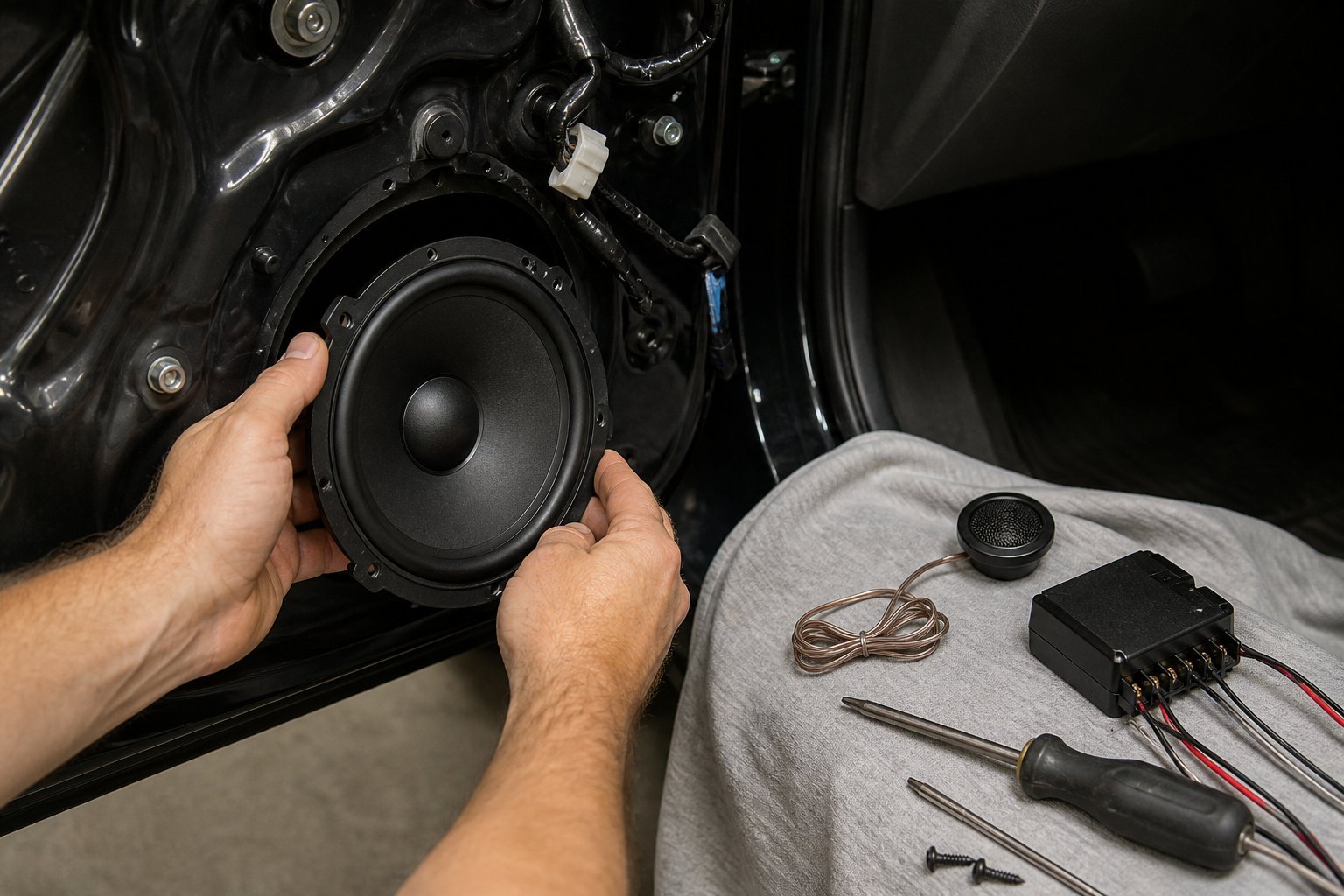
Component speakers split the woofer and the tweeter, so you can mount the tweeter high on the door or dash, close to ear level. That lifts the sound up and spreads it across the windshield instead of leaving it down by your knees, and it is the single biggest step toward the clear, detailed soundstage of the best car audio systems.
Focal’s Auditor EVO set, designed in France, pairs a polypropylene woofer with Focal’s inverted-dome Mylar tweeter and an external crossover. It handles 60 watts RMS with 91.5 dB sensitivity, so it sounds good on a strong head unit and even better on an amplifier. Expect a little more fitting work than a coaxial speaker, because the tweeter and crossover need their own homes.
- Separate tweeter for a higher, wider soundstage
- Clear, detailed treble from Focal’s inverted-dome tweeter
- 91.5 dB sensitivity works with or without an amp
- Two-year warranty
- More installation work than coaxials
- Tweeter mounting may need a custom spot
The best drop-in upgrade for factory systems
If you are keeping your factory stereo, or adding a new head unit without an amplifier, speaker sensitivity matters more than power handling. JBL’s Club 64 is rated at 93 dB with a 3-ohm load, so it plays louder and cleaner than most 6.5-inch speakers on the same small amount of power.
It also sounds good: a full silk-dome tweeter (with a 0 dB or +3 dB level switch to suit where it sits) keeps the treble smooth, and JBL’s Plus One woofer cone has more surface area than most cones of the same size for fuller mid-bass. It is a coaxial, so it simply replaces the factory speaker.
- High 93 dB sensitivity suits low-power stereos
- Smooth silk-dome tweeter with level switch
- Simple swap for factory speakers
- Not as wide a soundstage as a component set
- 3-ohm load is worth checking with your amp
Affordable speakers that beat factory paper cones
Pioneer’s A-Series MAX TS-A653FH is a sensible budget choice for the front or rear doors. It handles 75 watts RMS, has 91 dB sensitivity and a wide 40 Hz to 49 kHz frequency range, and Pioneer includes multi-fit adapters to help it drop into many factory openings.
It is a good rear-fill partner for the Focal components up front, or a cheap way to bring a whole car up to a much better standard than its original paper speakers.
- Low price for a name brand
- 75 W RMS handling
- Multi-fit installation adapters included
- Less refined treble than the Focal or JBL
Best amplifiers and subwoofers
Real bass without losing your trunk
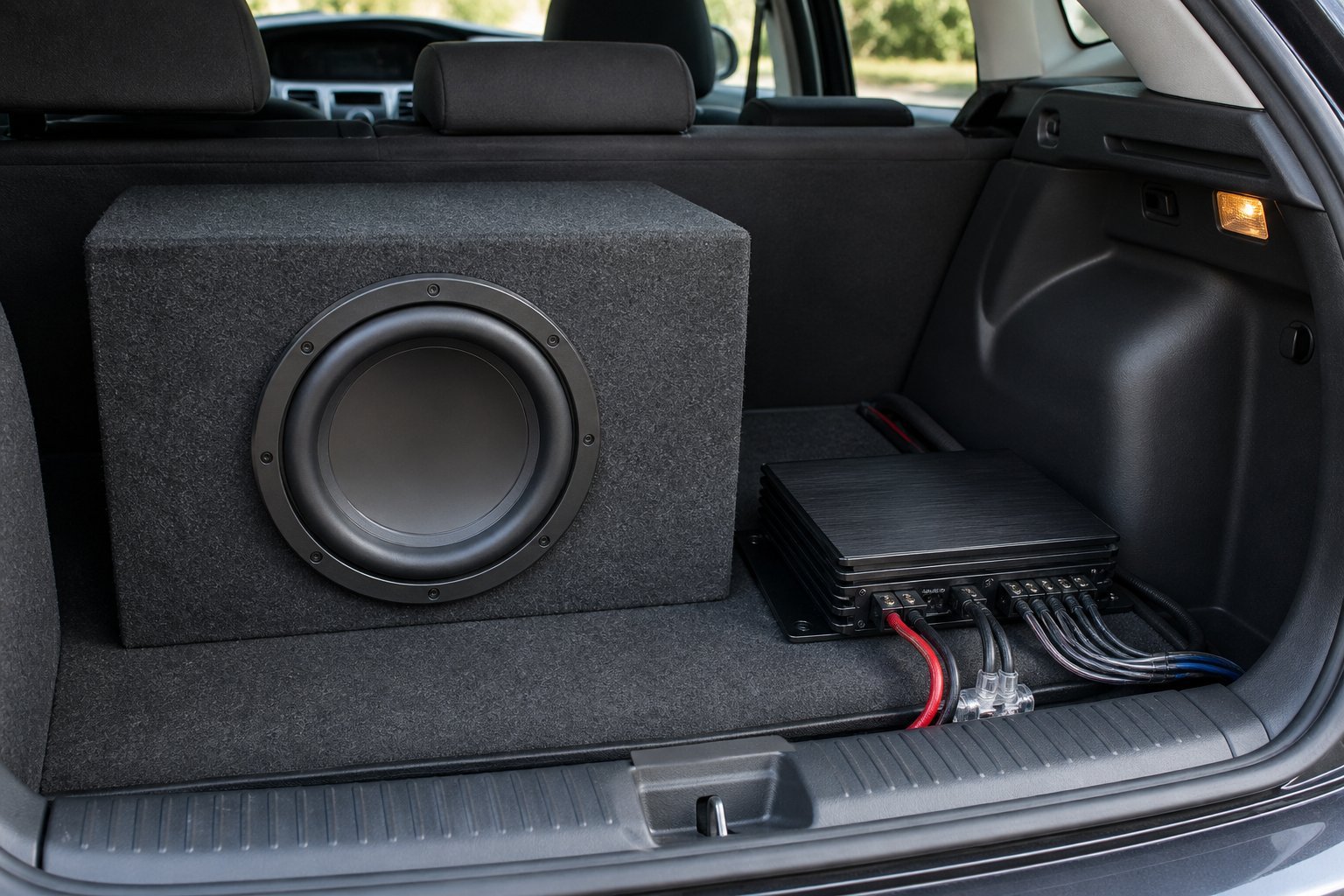
A subwoofer makes any system sound better, not just louder, because it takes the deep bass away from your door speakers so they can play mids and vocals cleanly. The JBL BassPro SL2 is the easiest way to add one. Its 8-inch driver and 125-watt RMS amplifier are built into a slim enclosure about 2.8 inches tall, so it slides under a front seat.
It plays down to 35 Hz, has adjustable bass boost, and accepts speaker-level inputs, so it works with a factory stereo as well as an aftermarket one. You will need a power wiring kit.
- Amp built in, so no extra amplifier needed
- Slim enough for under a seat
- Works with factory or aftermarket stereos
- An 8-inch sub won’t shake the car like a big 10 or 12
- Needs a wiring kit
Clean power for four speakers
A head unit’s built-in amplifier usually manages 15 to 22 watts of real (RMS) power per channel. That is fine at moderate volume, but at highway speeds the sound gets harsh as it runs out of headroom. Pioneer’s GM-A6704 delivers 60 watts RMS to each of four channels at 4 ohms, which is a good match for the Focal and Pioneer speakers here.
It is a Class AB design, the traditional choice for clean mids and highs, and it has adjustable high- and low-pass filters to keep deep bass out of your door speakers. You can also bridge it to 190 watts RMS x 2. Budget for an amplifier wiring kit too.
- 60 W RMS x 4 suits most aftermarket speakers
- High- and low-pass filters
- Bridgeable for flexible setups
- Class AB runs warmer and is larger than Class D
- Not powerful enough for a big subwoofer
Deep, tight bass for a custom build
If you have trunk space and want deeper, tighter bass than an under-seat sub can give, Kicker’s CompR 10 is a proven choice. It handles 400 watts RMS, has dual 2-ohm voice coils for flexible wiring, and Kicker’s forced-air cooling helps it run cooler for reliability.
This is a bare driver, so you will need an enclosure (Kicker suggests 0.8 to 1.25 cubic feet sealed, or 1.25 to 1.75 ported), a mono amplifier of around 400 watts RMS, and a wiring kit. A sealed box gives the tightest, most accurate bass for sound quality.
- 400 W RMS handling
- Dual voice coils make amp matching easy
- Forced-air cooling for reliability
- Needs a box, a mono amp and wiring
- Takes up trunk space
How to choose the best car audio system for your car
Check whether your dash takes a single-DIN or double-DIN stereo, and what size speakers your doors use. Many modern cars need an integration adapter to keep steering-wheel controls and warning chimes.
Time alignment and a many-band EQ do more for sound quality in a car than extra watts, because every seat sits at a different distance from each speaker.
RMS power is what an amplifier or speaker handles continuously; peak power is a marketing number. Sensitivity tells you how loud a speaker plays on a given amount of power.
Component sets mount the tweeter separately, higher up, for a better soundstage. Coaxials are easier to fit and are fine for rear doors.
Door speakers can’t play deep bass well. A sub lets them concentrate on vocals and instruments.
What makes a car audio system sound good?
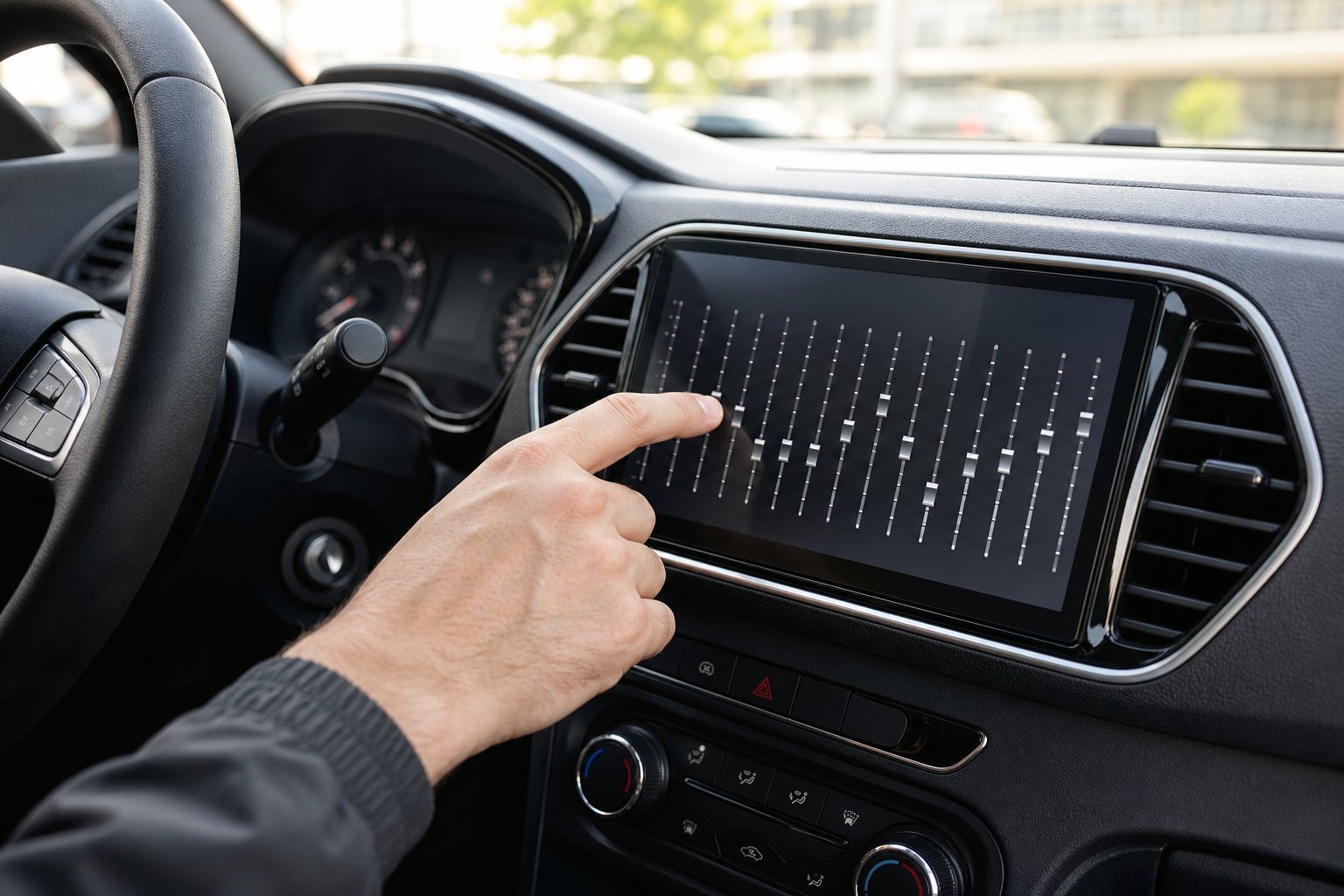
The cabin of a car is a tough place for sound. You sit far closer to one side’s speakers than the other, the doors rattle, glass reflects treble, and road noise drowns out bass. That is why the best car audio systems are about control and balance rather than raw power. A good head unit lets you delay the nearer speakers so sound from both sides arrives at your ears together, and an equalizer smooths out the peaks the cabin adds.
Speakers come next. Factory speakers are usually built to a cost, often with thin paper cones and small magnets. Crutchfield, one of the largest US car audio retailers, makes the same point in its car stereo buying tips. Swapping just the front pair for a quality set is often the most noticeable upgrade you can make. Our car speaker guides cover sizes and fit in more detail.
Finally, power and bass. An amplifier gives your speakers headroom, so music stays clean at highway volume, and a subwoofer takes over the lowest notes. Add them when your budget allows; see our amplifier and subwoofer guides for wiring and matching advice.
How to build a great-sounding car audio system in stages
-
Replace the head unit
Choose one with time alignment, a many-band EQ and pre-outs, such as the Sony XAV-AX6000. If your car’s stereo is built into the dash, look at a DSP or amplifier that works with the factory unit instead. See our head unit guides.
-
Upgrade the front speakers
Fit a component set like the Focal Auditor EVO in the front doors. This is where you hear the biggest change.
-
Add sound deadening to the front doors
Butyl deadening mats on the outer door skin stop rattles and improve mid-bass. It is cheap and makes any speaker sound better.
-
Add a subwoofer
A powered sub such as the JBL BassPro SL2 is the simplest choice. Set its crossover around 80 Hz so it blends with the doors.
-
Add a 4-channel amplifier
Power the front and rear speakers with an amp like the Pioneer GM-A6704, using the head unit’s high-pass filter to keep deep bass out of the doors.
-
Tune it
Set time alignment for the driver’s seat, keep the EQ mostly flat, and make small cuts rather than big boosts. Then set amp gains carefully so nothing distorts.
On most cars built in the last ten years, the stereo also runs warning chimes, steering-wheel buttons, parking sensors or vehicle settings. Before you replace it, check that an integration adapter (such as an iDatalink Maestro module, which the Kenwood and Sony support) is available for your car, and budget for it alongside the dash kit and harness.
Best car audio systems FAQ
What are the best car audio systems for sound quality?
The best car audio systems combine a head unit with proper tuning tools, good front speakers, an amplifier and a subwoofer. Our top picks are the Kenwood eXcelon DMX958XR head unit, Focal Auditor EVO component speakers, the Pioneer GM-A6704 amplifier and either a JBL BassPro SL2 or Kicker CompR 10 sub.
What should I upgrade first for better car sound?
For most cars, the front speakers give the biggest improvement for the money. If your factory stereo has no EQ or sound settings, replacing the head unit first gives you the tuning tools that help every later upgrade.
Do I need an amplifier for new car speakers?
Not always. High-sensitivity speakers such as the JBL Club 64 sound good on head unit power. An amplifier helps most if you play music loud, drive at highway speeds a lot, or choose component speakers.
Is a subwoofer worth it if I don't like heavy bass?
Yes. A subwoofer turned down low still takes the deepest notes away from your door speakers, so vocals and instruments sound cleaner. It is about balance, not volume.
Can I keep my steering-wheel controls with a new stereo?
Usually, yes. You’ll need the right steering-wheel control or integration adapter for your car. The Kenwood DMX958XR and Sony XAV-AX6000 both work with iDatalink Maestro modules.
What does time alignment do?
It slightly delays the speakers closest to you so that sound from every speaker reaches your ears at the same moment. The result is a clear stereo image in front of you instead of sound coming mostly from the nearest door.
The bottom line
The best car audio systems for sound quality are built step by step. Start with a head unit that lets you tune the sound (the Kenwood DMX958XR if budget allows, the Sony XAV-AX6000 for the best value), put a quality component set such as the Focal Auditor EVO in the front doors, then add a subwoofer and an amplifier. Do it in that order and every stage is an upgrade you can hear.