
If the electronics still work, you can replace a key fob shell yourself in about 15 minutes for the price of a takeout lunch.
A cracked case, a snapped key-ring loop or worn-out buttons don’t mean you need a new $200 fob. You move the circuit board, the battery, the transponder chip and the key blade into a new case, and the key works exactly as before, with no programming.
This guide shows US drivers how to do it, which shell to buy and the one step most people miss.
A new case, not a new key
Most "broken" key fobs have a broken case, not broken electronics.
The plastic shell takes the knocks, while the circuit board and chip inside keep working. Moving those parts into a new shell costs a few dollars and keeps the fob paired to your car, because the parts the car recognizes don’t change.
- When a new shell will fix your fob, and when it won't
- How to buy the right shell for your key
- Step-by-step: moving the parts across
- The transponder chip, the blade and fixing problems afterwards
The short answer
- No programming needed The car recognizes the circuit board and chip, not the plastic. Move them over and the key works as before.
- Cheap and quick Shells usually cost $10 to $30 and the swap takes a few minutes to a quarter of an hour.
- Don't forget the chip Many keys have a separate transponder chip in the case. Leave it behind and the car won’t start.
- Sort out the blade Either move your old blade across or have the new blank cut to match. It must turn your ignition and door lock.
- Match the shell exactly Same button layout, blade type, battery and chip holder as your original.
When you can replace a key fob shell
A shell swap fixes damage to the outside of the fob. Consumer Reports puts it simply: sometimes a fob still works, but the shell is damaged or the buttons are worn from use, and you can move the internal circuitry into a new shell. These are the signs a new case will help:
A cracked or split case. Once the halves start to separate, the battery or chip can fall out. Fix it before you lose a part.
A snapped key-ring loop. A very common failure. Without the loop, the fob hangs by a thread or comes off the ring entirely, and it’s easily lost.
A broken flip mechanism. On flip keys, the hinge, spring or the small pin holding the blade can fail. EngineerFix notes the hinge is a frequent point of failure, and the fix is to move the blade and its hardware into a new shell.
Worn or torn buttons. The rubber pad wears through, so the buttons are hard to press or no longer reach the switches on the circuit board. A new shell comes with a fresh pad.
A loose or snapped blade. If the blade has broken off the head but the electronics still work, a shell with a new blade, cut to your key, solves it.
When a new shell won’t help
A shell can’t fix broken electronics. If the fob is dead with a fresh battery, if a switch on the circuit board has broken off, or if the fob has been through the washing machine and corroded, you probably need a new fob. Check the battery first: our key fob battery guides show you how. And see our guide to a key fob not working for other quick checks before you buy anything.
What a new shell costs compared with a new fob
This is the main reason to replace a key fob shell. Consumer Reports found a replacement shell for a 2017 Chevrolet Cruze for $19.95 online, and moving the circuitry across took about two minutes. Most shells for mainstream US cars cost roughly $10 to $30, sometimes with a blank blade included.
A new fob is a different story. Consumer Reports says the fob alone can cost $50 to $400 depending on the brand, before $50 to $100 for programming and a backup key. Locksmith Ledger notes that as replacement remote head keys have become more expensive, many owners re-shell their keys instead, saving the programming the dealer would charge. See our replacement key fob cost guide for full prices.
If your shell comes with an uncut blade and you can’t move the old one, add the cost of cutting. A Lexus owner on a club forum reported paying $35 for a locksmith to cut a key, and ClubLexus members mention dealers charging about $30 to $70 to copy one. Ordinary edge-cut blades are usually cheaper to cut.

If the key still works but the case is worn or cracked, a new shell costs a fraction of a new fob.
What’s inside your key fob
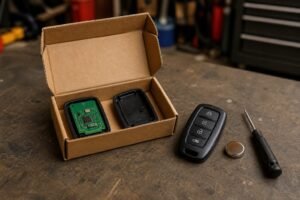
Before you open anything, it helps to know what you’re looking for. Most remote keys and flip keys contain four parts you’ll reuse.
The circuit board. The green board with the button switches, which sends the lock and unlock signals. It usually sits in a groove or clips into one half of the case.
The battery. A coin cell such as a CR2032 or CR2025, held in a clip on the board or in its own compartment. It’s a good moment to fit a new one.
The transponder chip. The part that lets the car start. EngineerFix explains it’s usually a tiny carbon pellet or glass capsule, or it may be built into the circuit board itself. In many keys it’s a separate part, pressed or glued into a slot near the blade. Transferring it is the most important step.
The key blade. The metal key, fixed into the shell or held in a flip mechanism by a small roll pin. It must be cut to your car’s locks.
Smart keys for push-button cars have a circuit board, battery and a separate emergency blade that slides out. Some, such as older Toyota Prius smart keys, also have a separate chip, as we’ll see below.
How to buy the right shell
A shell that looks right but differs inside will cause problems. Check these points against your original before you order.
Button layout. The same number of buttons, in the same places. A four-button shell won’t line up with a three-button board.
Blade type. Edge-cut or laser-cut (a wavy groove down the middle of the blade), and the same blade profile. Many sellers list the blade code, such as HU66 or TOY43. Match it.
Battery and board fit. The shell must hold your board and battery the same way. Compare the seller’s photos of the inside with your opened fob.
A place for the chip. Make sure the new shell has a slot or holder for a separate transponder chip if your key has one. On the Crossfire Forum, one owner found some replacement shells don’t include the plastic insert that holds the chip, so the chip moved around and the car wouldn’t start reliably.
Blade included or not. Some shells come with an uncut blank; some expect you to move your old blade. Decide which you’ll do before you buy.
Read reviews that mention your exact year, make and model. Cheap shells vary in quality: thin plastic, buttons that don’t line up and loose hinges are common complaints.
Tools you’ll need
Not many. An Instructables guide to the job lists a Phillips screwdriver, a flathead screwdriver, pliers, a small hammer and a pin punch, plus the new shell. Add a pair of tweezers for the chip, a plastic pry tool or old guitar pick to open the case without scratching it, a drop of superglue, and your phone camera. A small tray or bowl stops tiny parts rolling away.
Work on a clean, well-lit table, ideally on a light-colored cloth, so you can see a small black chip or a spring if one drops out.
How to replace a key fob shell, step by step
The details vary by key, so look for a guide or video for your exact model too. iFixit has a photo guide for Toyota keys, for example. But the general process is the same for most remote keys and flip keys.
1. Photograph everything. Take pictures of the old fob from both sides, then again at each stage as you open it. EngineerFix recommends a photo of how the parts sit before you remove them; it makes reassembly much easier.
2. Open the old case. Remove any screw, then gently pry the two halves apart along the seam with a plastic tool. Start at the end away from the blade. Go slowly: the old plastic may crack further.
3. Remove the battery and circuit board. Note which way up the battery sits. Lift the board out by its edges, without touching the contacts or bending the switches.
4. Find and remove the transponder chip. Look near the blade end for a small black or glass part sitting on its own in a slot. If it’s glued in, ease it out carefully with a small screwdriver. Don’t crush or crack it. If you can’t find a separate chip, it may be on the board.
5. Deal with the blade. To move your old blade, tap out the roll pin that holds it with a pin punch and small hammer, then fit it into the new shell and tap the pin back in. Or use the new shell’s blade, cut to match by a locksmith. More on this below.
6. Fit everything into the new shell. Put the chip in its slot first, the right way round, with a small drop of glue if it’s loose. Then fit the board, making sure the buttons line up with the switches, and the battery, the right way up.
7. Close and test. Snap or screw the halves together. Test lock, unlock and the trunk button, then start the car. Only throw the old case away once everything works.

The circuit board is the part you reuse. Handle it by the edges and keep the switches undamaged.
The transponder chip: the step people miss
If you replace a key fob shell and the buttons work but the car won’t start, the chip is almost always the reason. The remote and the chip are separate. The remote opens the doors; the chip tells the immobilizer the key is genuine. Leave the chip behind and the doors open, but the engine won’t run.
Car forums are full of this story. A Crossfire owner admitted he’d assumed the chip was on the circuit board, then found it wedged in the corner of the old case; once he moved it over, the car started. On PriusChat, members explained that 2004 to 2009 Prius smart keys have a separate chip, about half an inch long, as well as the circuit board.
Here’s a quick test if the car won’t start after the swap. Hold the old empty case right next to the new key while you start the car. If the engine starts, the chip is still in the old case. Owners on the Fiat Forum suggest exactly this check.
Fix the chip in place. Owners on the ScionLife forum note that the chip’s orientation matters, and suggest a small drop of superglue to hold it. A 350Z owner reported that his loose chip moved after the key was dropped a few times, and the car wouldn’t start until he fixed it.
What to do about the key blade
You have two choices, and both work. Pick the one that suits your shell and your key.
Move your old blade. On most flip keys, the blade is held by a small roll pin. Tap it out with a pin punch, fit the blade into the new shell’s hinge, and tap the pin back in. Your key turns the locks exactly as before, and there’s nothing to cut. The pin can be stubborn; support the shell well and use light taps.
Have the new blank cut. If the blade is molded into the old head, or it’s worn, get the new shell’s blank cut to match. A locksmith or dealer copies your old blade, or cuts it from the key code. Do this before you move the electronics, so you can test that the blade turns the ignition and door locks.
Laser-cut blades need special machines, and not every locksmith has one. One ClubLexus member said nine out of ten local locksmiths couldn’t cut his Lexus key. Call ahead and ask before you drive over.
Hardware stores can often cut a plain edge-cut blank in minutes. Remember that the new blade doesn’t need programming, because the chip that starts the car is the one you moved from your old key.
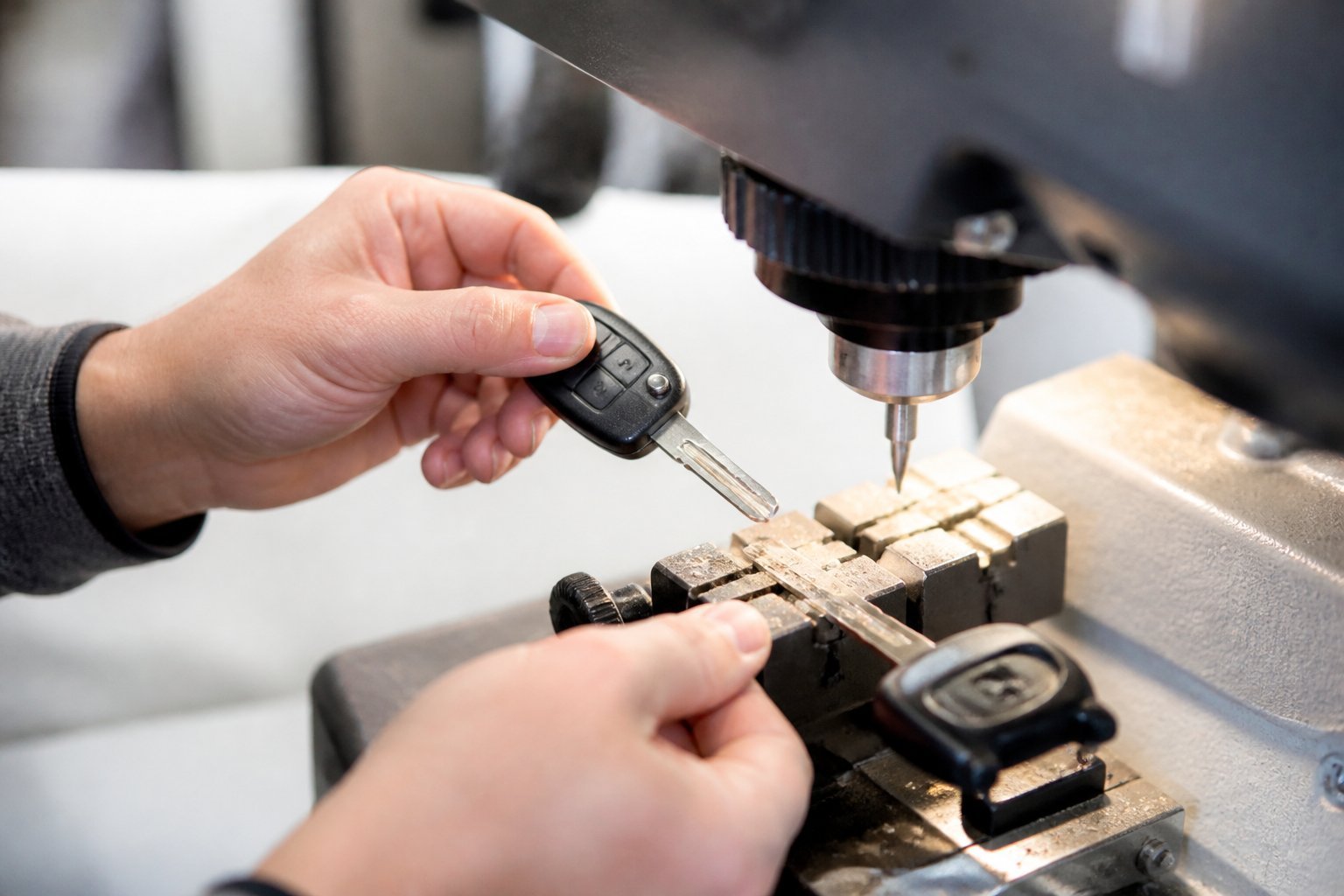
If you use the new shell’s blank blade, a locksmith or hardware store cuts it to match your old key.
Should you replace a key fob shell or buy a new fob?
For most damaged keys, the shell wins easily. If the fob still locks and unlocks the car and the engine starts, the expensive parts are fine, and a new case is all you need. You keep your original, factory-paired electronics, which are usually better quality than a cheap aftermarket fob.
Buy a new fob instead if the circuit board is damaged, a switch has broken off the board, the fob has been soaked and corroded, or the transponder chip is cracked. In those cases a new shell just puts broken parts in a nicer case. Also consider a new fob if you need a spare anyway: you can program the new one and keep the repaired original as your backup.
If you’re unsure, open the old fob and look. A clean circuit board with intact switches and a whole transponder chip means a new shell will do the job.
Can you replace a smart key shell?
Usually, yes. Many smart keys for push-button cars have replacement shells, and the swap is often simpler than for a flip key, because there’s no hinge. Open the case, move the circuit board and battery, check for a separate chip, and move the emergency blade into the new case. Cut a new emergency blade if the shell’s blade is a blank.
Take extra care with the board: smart key boards are more delicate, and some have the antenna as a separate coil. If your car’s push-button start uses a backup slot or spot to read the key when its battery is low, check that it still works after the swap. On PriusChat, an owner found the key slot didn’t work because the chip had not been moved into a replacement case.
Troubleshooting after the swap
The buttons work, but the car won’t start. The chip was left behind, is loose, or is upside down. Try the old-case test above, then refit and glue it.
The car starts, then dies after a second or two. This usually means the immobilizer isn’t reading the chip properly. One Crossfire owner described exactly this after a shell swap. Check the chip’s position and that it isn’t cracked.
The buttons don’t work. Check the battery is the right way up and touching both contacts, and that the board sits fully in its groove so the switches line up with the rubber pad. A pad that’s slightly the wrong shape can miss the switches.
The blade won’t turn the ignition. The new blank isn’t cut correctly, or the old blade went in upside down. Have the cut checked against your old key. If the fob seems to have lost its pairing, see our key fob programming guides; a re-sync is rarely needed after a shell swap, but some cars offer a simple routine if it is.
When to let a locksmith do it
If you’d rather not do it yourself, many automotive locksmiths will replace a key fob shell for you, usually quickly and for much less than a new fob. Locksmith Ledger points out that moving the electronics to a shell and cutting the key doesn’t need cloning or programming, which keeps the job cheap. It’s a good choice if your key has a laser-cut blade, a stubborn roll pin or a fragile smart key board.
It also makes sense if you only have one key. If something goes wrong while you replace a key fob shell on your only key, you could be stranded. If that’s you, read our guide on how to get a spare car key first, and see our key fob case and repair guides for other fixes.

Many locksmiths will swap your key into a new shell and cut the blade in one visit.
Key fob shell swap at a glance
-
Buy the matching shell
Match the buttons, blade type, battery fit and chip holder to your original.
-
Photograph the old fob
Take photos before and during disassembly so you know where everything goes.
-
Open and remove the parts
Take out the battery, circuit board and the separate transponder chip if there is one.
-
Move or cut the blade
Tap out the roll pin to move your old blade, or have the new blank cut to match.
-
Fit the parts in the new shell
Chip first, the right way round, then the board and a fresh battery.
-
Test before you throw anything away
Check every button, the locks and that the car starts. Keep the old case until it all works.
Key fob shell myths
False. The car recognizes the circuit board and chip, which you move across, so no programming is needed.
Not if the transponder chip was left in the old case. The remote and the chip are separate.
False. A $10 to $30 shell fixes most cracked cases, broken loops and worn buttons.
Not always. Button layout, blade type, battery fit and the chip holder must all match.
Key fob shell replacement: FAQs
Can I replace a key fob shell myself?
Yes, if the electronics still work. Open the old case, move the circuit board, battery, transponder chip and blade into a matching new shell, and test it.
Do I need to reprogram my key after a new shell?
No. You reuse the original circuit board and chip, so the car recognizes the key as before.
Why won't my car start after replacing the key shell?
Usually the transponder chip was left in the old case, or it’s loose or the wrong way round. Hold the old case next to the key and try starting the car to check.
How much does a key fob shell cost?
Most shells for US cars cost about $10 to $30. Add the cost of cutting the blade if you don’t move your old one.
Do I need to get the new key blade cut?
Only if you use the shell’s blank blade. You can usually move your old blade across by tapping out its roll pin instead.
Can a locksmith replace my key fob shell?
Yes. Many automotive locksmiths do it quickly and cheaply, and can cut a new blade at the same time.
The bottom line
- A $10 to $30 shell can save you a $200+ fob
- Always move the transponder chip, and fix it in place
- Use a locksmith for laser-cut blades or your only key
If your key fob still works but the case is cracked, the loop has snapped or the buttons are worn, a new shell is the cheap fix. Buy a shell that matches your original exactly, photograph each step, move the circuit board, battery and transponder chip, and either move your old blade or have the new one cut. Test everything before you throw the old case away.