Best replacement key fobs you can program yourself
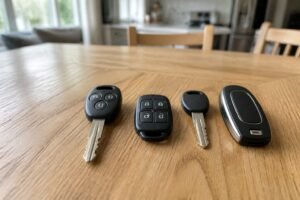
A dealer will happily charge you for a new key fob and again for programming it. The good news is that plenty of cars let you skip that bill. There are two kinds of replacement key fobs you can program yourself. Older turn-key cars from Ford, GM, Honda and Toyota can learn a new keyless entry remote through a simple sequence of ignition turns and button presses, with no tool at all. Newer cars, including many push-button-start models, need a diagnostic tool, and DIY kits now bundle a small OBD plug-in programmer with the fob so you can do it at home.
We picked eight replacement key fobs you can program yourself: four DIY kits with their own programmer and four self-programming remotes that need nothing but your car and the instructions. The live prices in the tables update automatically.
- Four fob-and-programmer kits for newer cars
- Four no-tool remotes for older turn-key cars
- What each one needs from you before you start
- Live prices that update automatically
Key takeaways
- Know which kind your car takes Older turn-key cars often use onboard programming with no tool. Smart keys and most newer remotes need an OBD programmer kit.
- Keep one working key Almost every DIY method needs at least one working key. If every key is lost, call a locksmith or dealer.
- Match the FCC ID and part number A fob that looks right but has a different FCC ID, board or frequency will not pair, whatever the instructions say.
- Remote and immobilizer are separate Programming the buttons does not always teach the car’s immobilizer a new chip. Separate remotes avoid that problem.
Our best replacement key fobs you can program yourself at a glance


DIY key fob and programmer kits compared
|
Best overall
Ford kit
|
Best smart key
Highlander kit
|
Best for Honda
Honda kit
|
Best for Jeep
Jeep kit
|
|
|---|---|---|---|---|
|
|
|
 |
 |
|
| Fits | 2004–17 F-150, Explorer, Edge and more | 2014–19 Highlander, 2020–21 Sequoia | 2017–22 CR-V, 2016–20 Pilot | 2014–18 Cherokee |
| FCC ID | CWTWB1U793 | HYQ14FBA | KR5V2X | GQ4-54T |
| Ignition | Turn key | Push start | Push start | Push start |
| In the box | 2 keys + OBD tool | Smart key + OBD tool | Smart key + OBD tool | Smart key + app programmer |
| Our score | 9.1 /10 | 8.8 /10 | 8.5 /10 | 8.3 /10 |
| Price | – | – | – | – |
| View | View | View | View |
Self-programming remotes compared (no tool needed)
|
Best no-tool
Ford 2-pack
|
Older Hondas
Honda 2-pack
|
GM trucks
GM 2-pack
|
Older Toyotas
Toyota remote
|
|
|---|---|---|---|---|
|
|
|
 |
 |
|
| Fits | 1998–2016 Ford, Lincoln, Mercury | 2003–07 Accord, Element | 2001–11 Silverado, Tahoe, Suburban | 2006–10 RAV4, 2007–12 Yaris |
| FCC ID | CWTWB1U345 | OUCG8D-380H-A | KOBUT1BT | HYQ12BBY |
| Remotes | 2 | 2 | 2 | 1 |
| Our score | 8.9 /10 | 8.6 /10 | 8.4 /10 | 8.2 /10 |
| Price | – | – | – | – |
| View | View | View | View |
DIY programmer kits: detailed reviews
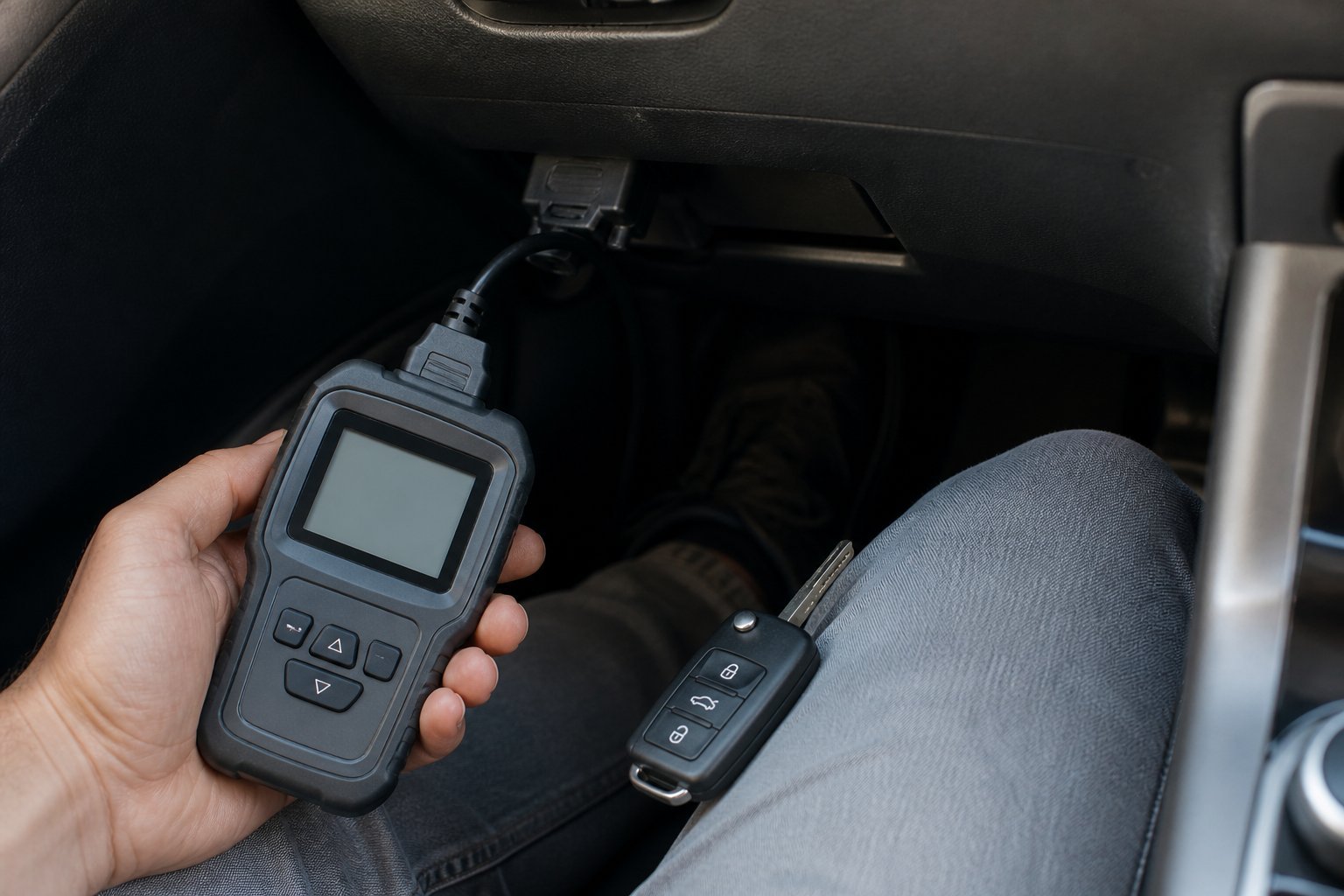
Two Ford 3-button remote head keys with a plug-in OBD II programming tool
Ford’s remote head keys combine the buttons and the immobilizer chip in one key, and the car’s anti-theft system normally needs two working keys or a diagnostic tool to learn a new one. This kit solves that with a matching OBD II tool. You plug it into the port under the dash, follow the on-screen steps and the illustrated manual, and both keys are set up at home.
The fitment list is long: Edge 2007–15, Escape 2005–12, Expedition 2005–16, Explorer 2004–15, F-150 2004–14, Super Duty 2004–16, Flex, Fusion 2006–12, Ranger 2007–11 and more. It uses FCC ID CWTWB1U793 or OUC6000022, 315 MHz and a 4D63 chip, and you get two keys in the box, which makes it one of the best value replacement key fobs you can program yourself. The blades come uncut, so have them cut first, and you need at least one working key. It is for turn-key Fords only, not push-button-start models.
- Two keys and the programmer in one box
- Covers a huge range of 2004–2017 Fords
- Programs the chip as well as the buttons
- Blades must be cut before use
- Needs one working key
- Turn-key models only
A push-start Toyota smart key packaged with its own OBD programming tool
Toyota smart keys are a classic locksmith job, because there is no button-press routine that teaches the car a new proximity key. This kit includes the OBD tool that does it. Plug it in, follow the screen and the manual, and the new key works with push-button start and keyless entry.
The listing gives everything you need to check: FCC ID HYQ14FBA, AG board 281451-2110, OE numbers 89904-0E120 and 89904-0E121, 314.3 MHz. That board number matters, because Toyota used several boards under the same FCC ID, and the wrong one will not pair. The kit needs at least one working key, and the seller warns that the fob is not waterproof and the screen is hard to read in bright sun, so do the setup in a garage.
- Turns a locksmith-only smart key into a home job
- Board and OE numbers listed precisely
- Battery pre-installed and pre-tested
- Needs one working key
- Narrow model coverage
- Single key per kit
A Honda proximity key with emergency blade and a plug-in programming tool
Honda’s newer smart keys cannot be added with the old ignition-and-lock-button routine, so most owners end up at the dealer. ATPSTOGO’s kit includes the OBD tool, the manual and the emergency insert blade, which many bare fobs leave out.
It replaces FCC ID KR5V2X (V44), Continental A2C98317200, with part numbers 72147-TG7-A11, 72147-TLA-A01 and 72147-TLA-A02. Note the Civic fitment: it is for the 2018–2021 5-door hatchback only, not the sedan or coupe. The listing points out that the chip is a 47, which you select in the tool. It supports push-button-start cars only. Have a working key ready, and get the emergency blade cut if you want to use it.
- Emergency blade included
- Three popular Hondas covered
- Clear chip and part numbers
- Civic hatchback only, not sedan
- Push-start models only
- Blade needs cutting
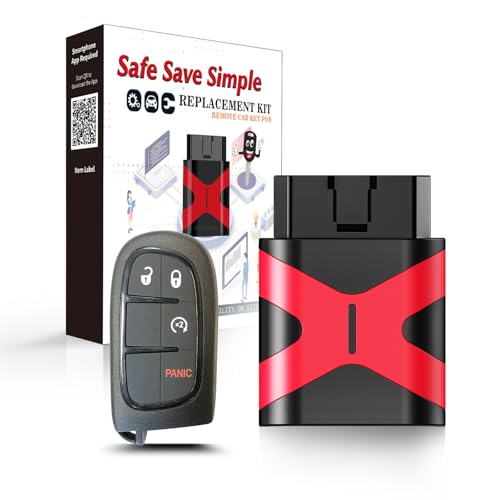
A Cherokee smart key with an app-guided OBD programmer
This kit pairs a Cherokee smart key with a programmer that you run through a phone app. Download the app, connect the device to the OBD port and follow the step-by-step screens; the seller says it takes a few minutes.
There is a catch worth knowing before you buy. The programmer locks to a single vehicle’s VIN, although it can pair up to eight keys to that car. That is fine if you want spares for one Cherokee, but you cannot lend it to a friend afterwards. It is only for the 2014–2018 Cherokee with FCC ID GQ4-54T and a 4A chip, so check both on your original. The listing says less than ATPSTOGO’s about the working-key requirement, so assume you will need one.
- Pair up to eight keys to one Jeep
- App guides you step by step
- No dealer appointment
- Programmer works with one car only
- Needs a smartphone
- Thin listing detail
No-tool self-programming remotes: detailed reviews
Two separate Ford remotes that pair through Ford’s ignition-cycle routine
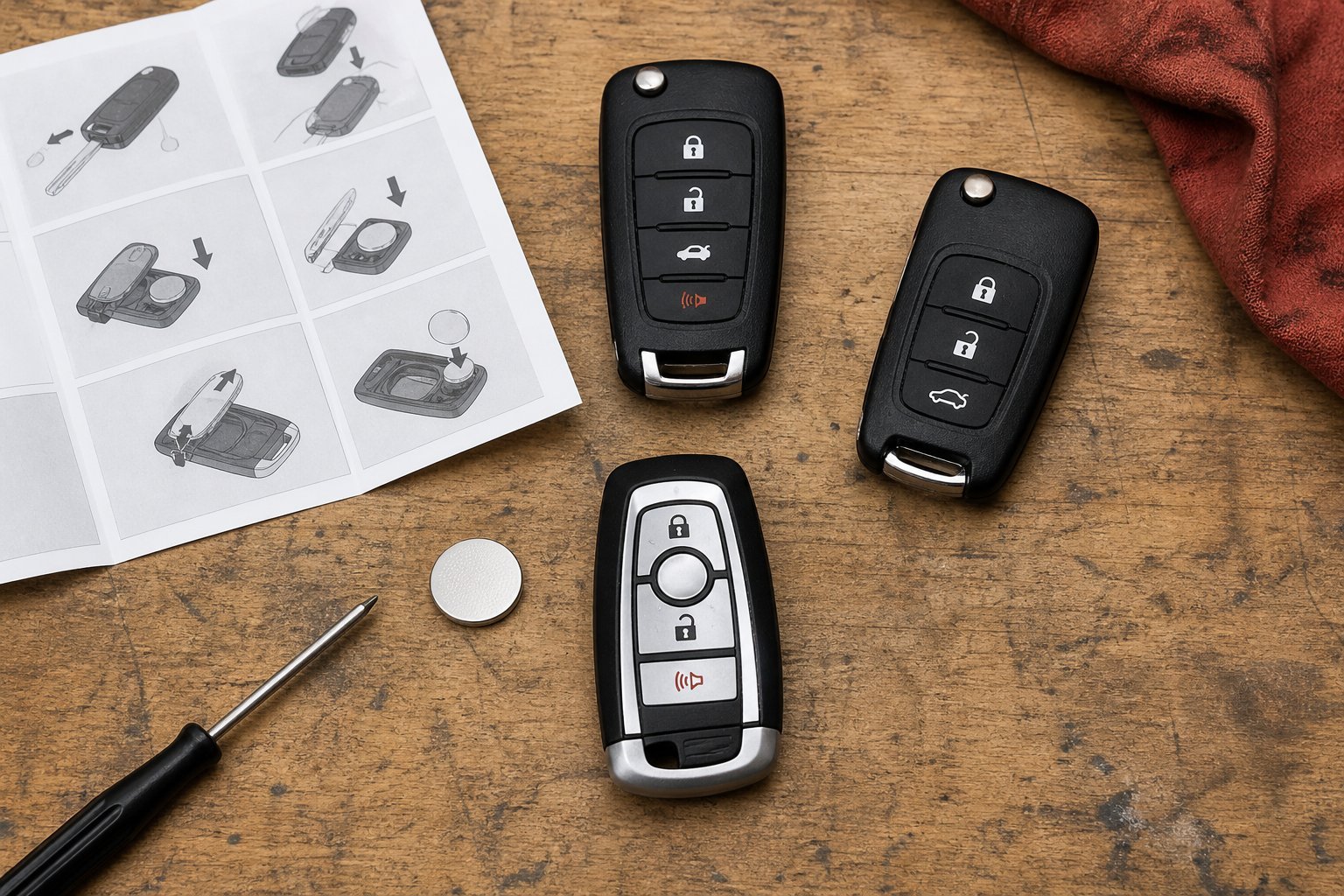
Ford’s separate keyless entry remotes are the best-known example of a fob you can program yourself. Ford’s onboard routine uses a quick series of ignition turns until the locks cycle, then a press of a button on each remote, and it needs nothing but your normal ignition key. KeylessOption includes the instructions, so most owners are done in a few minutes.
The pack holds two 3-button remotes (lock, unlock, panic) and replaces FCC IDs CWTWB1U345, CWTWB1U331, CWTWB1U212 and GQ43VT11T, with OEM numbers such as 8L3Z-15K601-AA. Because it is a separate remote, not a key, there is no blade to cut or chip to program. One tip from Ford owners: the onboard routine erases every remote not present, so pair all of your remotes in the same session. It carries a 90-day warranty.
- No tool, no blade, no chip
- Two remotes for a very low price
- Fits a long run of Ford models
- 90-day warranty is short
- 3-button layout (no trunk button)
- Only for cars with a separate remote
Two separate Honda remotes that you program with the car’s own ignition-and-button routine
Hondas of this era have one of the friendliest onboard routines: a sequence of ignition-on and lock-button presses puts the car into programming mode, and it learns each remote in turn. USARemote supplies step-by-step instructions, and the pack includes two remotes, each with its electronics and battery fitted.
It replaces FCC ID OUCG8D-380H-A, part 35118-SDA-A11. Read the listing’s own warning: the remote is user programmable, but a key must be cut and programmed by a locksmith or dealer. In other words, this is for Accords and Elements that use a separate remote next to the ignition key, not the later remote head key. Check that your original fob has no blade and matches the FCC ID.
- Honda’s simple onboard routine
- Two remotes in the pack
- Battery and electronics installed
- Separate-remote models only
- Narrow year range
- Ignition key is a separate job
Two GM truck remotes sold as self-programmable, with instructions
GM trucks of this generation can learn a new remote without a scan tool on many models, using a door-switch and ignition routine or the Driver Information Center. KeylessOption sells this pair as self-programming and includes the instructions, so you can add or replace remotes in the driveway.
It replaces OEM numbers 15042968 and 15732803, FCC IDs KOBLEAR1XT and KOBUT1BT, with lock, unlock and panic buttons. The fitment covers a long run of Silverado, Tahoe and Suburban trucks, but GM’s procedure changed over those years, so read the instructions for your exact model year before you start. If your truck has a 4-button remote with remote start, this 3-button version will not add that feature.
- Two remotes for little money
- Common Silverado, Tahoe, Suburban fit
- Instructions included
- Procedure varies by model year
- 3-button only, no remote start
- 90-day warranty
A Toyota remote built for at-home pairing, with instructions
Many Toyota remotes can technically be paired at home, but plenty of cheap HYQ12BBY listings tell you, in the small print, to see a locksmith. Remote2program’s listing is explicit that this one supports self-programming, with instructions you can follow at home, which is why it made our list ahead of cheaper look-alikes.
It covers the 2006–2010 RAV4, 2007–2012 Yaris and 2008–2013 Scion xB with FCC ID HYQ12BBY, and it arrives pre-tested with a battery. You get one remote, and it only works the functions your car came with from the factory. The listing mentions a 4D67 chip for the RAV4, so if your car uses a key with the chip in it, budget for a cut and chip program separately. It costs more than a basic remote, which buys the self-programming support.
- Explicitly supports self-programming
- Pre-tested with battery
- Covers three small Toyota and Scion models
- One remote per pack
- Pricier than bare remotes
- Narrow fitment
Why DIY programming fails, and how to avoid it
The most common complaint about replacement key fobs you can program yourself is that the fob simply will not pair. The fob is rarely faulty. Usually the FCC ID matches but the part number, board or frequency does not, or the car never supported onboard programming in the first place. Toyota alone used several boards under the same FCC ID, and GM changed its procedure several times within a single truck generation. Check every number printed on your old fob, not just the photo.
The second complaint is a remote that locks and unlocks but will not start the car. That happens when the fob includes a key blade with a transponder chip. Pairing the buttons is one job; teaching the immobilizer a new chip is another, and on many cars it needs two working keys or a tool. Separate remotes, like the four no-tool picks here, avoid the problem entirely because your existing ignition key keeps starting the car.
The third is the all-keys-lost situation. Every kit and routine on this list needs at least one working key or a running car. With no key left, a mobile locksmith or dealer is the only route. If you are not sure whether your car supports DIY pairing at all, our step-by-step guide to programming a key fob yourself walks through the common methods, and J.D. Power’s guide to key chip programming explains when a professional tool is unavoidable.
How to choose replacement key fobs you can program yourself
Older turn-key Fords, GM trucks, Hondas and some Toyotas can learn a separate remote through ignition and button sequences. Smart keys and most newer cars need a programmer.
The FCC ID is on the back of the fob or inside the battery cover. Toyota and Honda keys also have board or chip numbers that must match.
Some listings titled “self programmable” say lower down that a locksmith or dealer must program them.
DIY programmers and onboard routines need at least one working key, and some programmers lock to one VIN.
Smart key kits only fit push-button-start cars; separate remotes and head keys fit turn-key cars.
How to program a replacement key fob yourself
-
Confirm the fob matches
Compare the FCC ID, part number, button layout and frequency with your old fob before you open the package.
-
Gather every remote
Many onboard routines erase any remote that is not paired in the same session, so have all of your fobs with you.
-
Follow the method for your car
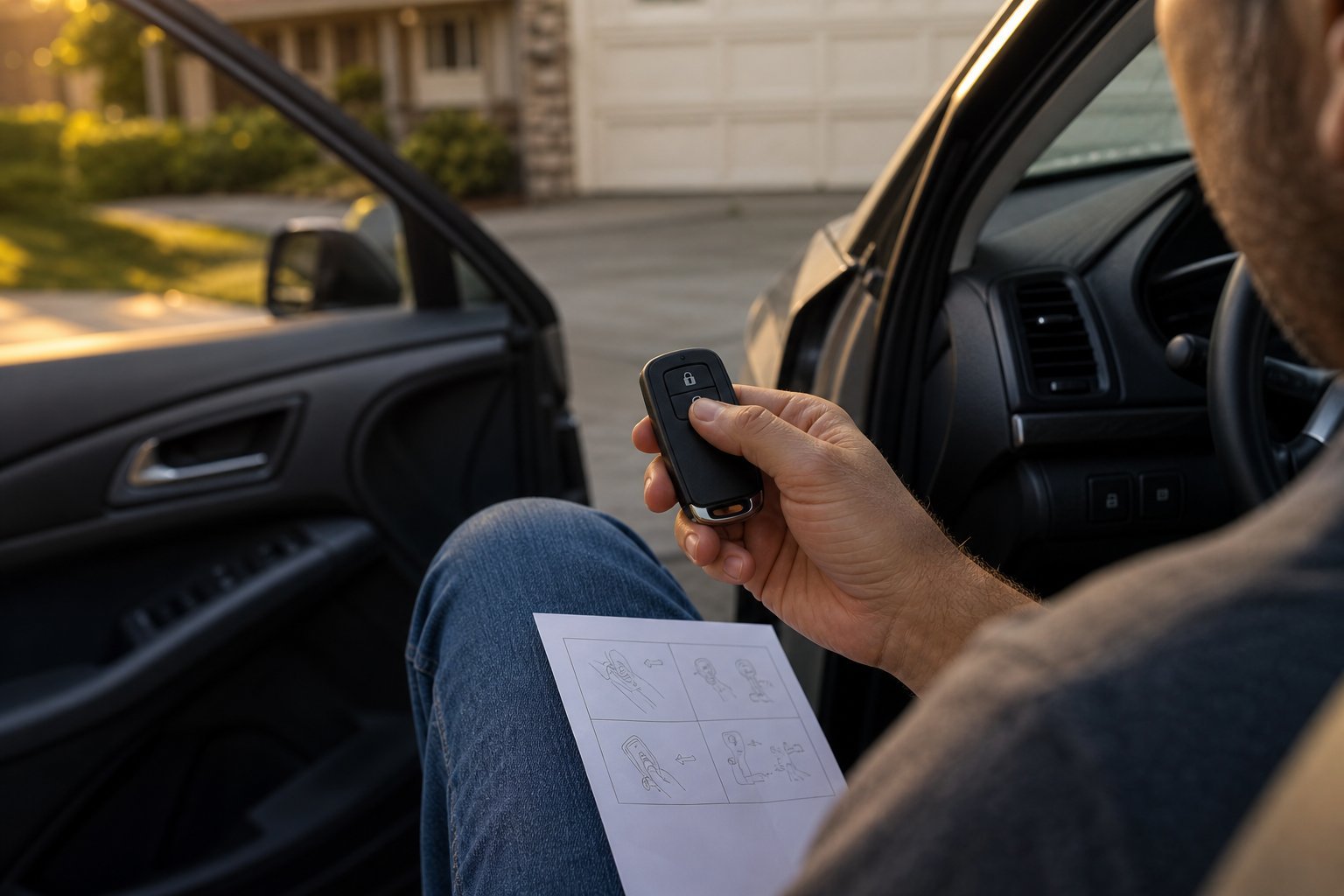
For a separate remote, follow the seller’s ignition and button sequence exactly and within the time limits. For a kit, plug the OBD tool into the port under the dash and follow the screen.
-
Test every button and the start
Check lock, unlock, panic and trunk, then confirm that the car starts with the key or smart key you just added.
-
Cut any blade
If the fob has a key blade or emergency key, have it cut at a hardware store or locksmith and test it in the door.
A fob that only works up close is often just a weak coin cell. Replace it before you buy anything: our key fob battery guide lists the cells worth buying, and this guide explains whether you need to re-pair afterwards.
Programming a key fob yourself: FAQ
Can I really program a replacement key fob myself?
On many cars, yes. Older Fords, GM trucks, Hondas and some Toyotas with separate remotes have onboard routines that need no tool. Newer cars and smart keys usually need an OBD programmer, which DIY kits now include.
Do I need a working key to program a new fob?
Almost always. Every kit and onboard routine on this list needs at least one working key or a car you can start. With all keys lost, you need a locksmith or dealer.
Why does my new fob unlock the car but not start it?
The buttons were paired, but the transponder chip in the key was not. On many cars the immobilizer needs a tool or two working keys to learn a new chip. A separate remote avoids this, because your existing key still starts the car.
Can I reuse a DIY programmer on another car?
Often not. Some programmers, such as the Jeep kit here, lock to the first VIN they connect to. Treat a kit as being for one car unless the seller says otherwise.
Are cheap self-programmable fobs reliable?
Many are fine, but read the listing closely. Some cheap fobs labeled self-programmable say in the details that a locksmith must program them. Pick sellers that list exact FCC IDs and include clear instructions.
The bottom line
- Older turn-key car: a no-tool remote is cheapest
- Newer car or smart key: choose a kit with a programmer
- Match the FCC ID, part number and board
- Keep at least one working key
The best replacement key fobs you can program yourself match your car exactly and are honest about what they need. ATPSTOGO’s Ford kit is our top pick because it includes two keys and the tool that teaches the immobilizer, while the Highlander and CR-V kits do the same for Toyota and Honda smart keys. If your car uses a separate remote, the KeylessOption Ford pair is the easiest fix of all, and the USARemote Honda, KeylessOption GM and Remote2program Toyota remotes cover three more popular brands without any tool.